The Fear of Micromanagement Prevents Active Management

“I trust my team to do it the best way possible.”

“If something’s wrong, they’ll tell me about it.”

These are comments I hear from managers talking about how they empower their teams. Sadly, they are doing the opposite. A lot of this comes from the fear of micromanagement. Who hasn’t read or heard a story of a horrible boss that micromanages everyone? No one wants to hear that about themselves! In fact, if you were to ask managers what their largest fears are, a common response is the fear of being known as a micromanager. That’s why I’ve observed so many potentially great managers handicap themselves. They stop actively managing due the fear of micromanaging.

To understand this difference, let’s first define micromanagement vs. active management:

  • Micromanagement: “excessive supervision and control of employees’ work and processes, as well as a limited delegation of tasks or decisions to staff”
  • Active Management: “tracking the performance of employees’ work and providing feedback and guidance on how to improve.”

Both of these definitions involved overseeing and reviewing work in detail. The difference is that a micromanager will state, “get out of the way, I’ll just do it.” or “just do it this way.” Whereas the active manager will say “while this way worked, have you thought about handling it in this way? Do you see how while that response, while correct, could be offensive?”

To give another example, while leading the support team at a collaboration software company, I was working on making the support team more scalable. We had left the team to their own devices to manage their queue, and how to solve tickets to individuals themselves with just high level goals. Here is the breakdown on what we found:

  • 10% of individuals averaged between 90-110 tickets a week.
  • 25% of individuals averaged between 60-70 tickets a week.
  • 30% of individuals averaged around 50 tickets a week.
  • 25% of individuals averaged between 25-30 tickets a week.
  • 10% of individuals averaged between 15-25 tickets a week.

Knowledge, tenure, and hours worked were all similar. CSAT was actually highest with the top producers (so not only highest quantity, but highest quality as well). What this proved, was that left to their own devices, while everyone can find a way to get their work done, only 10% of people will find the ideal way to get their work done! From this lesson, we started shadowing the top 10% to see what they did differently, and started training the rest of the team on these best practices. This change management was surprisingly difficult as some individuals were so entrenched in their belief that “their way was the best way,” due to us not having set this expectation before. While this training did not achieve the desired nirvana of getting the remaining 90% up to the top 10% of performance, it did move everyone up at least one category with everyone above the 50 tickets a week level–a massive performance boost for the entire organization!

Additionally this kind of feedback should be delivered in a near real-time fashion. Each individual is different in how they like to receive feedback, so I typically do this on a weekly basis in my direct reports’ one on one meetings.

For those that still do not believe, I will end with this quote from a direct report who I started managing for about a month: “Thank you for the feedback. I have been asking for years on how I can improve, and what I need to do to get better. You are the first person to have the courage to actually tell me. Now that I know, I can actually work on these items.” Top performers want and need this feedback on how to improve. It’s bottom performers that don’t want the feedback and challenge this model.
How to Structure Customer Success?

I once told my parents I inherited the Hosting organization (i.e. data center team). Two years later I overheard my mom telling a friend “my son’s the official greeter for the company!” She was thinking in restaurant terms apparently! Lesson learned: explaining what we do, correctly and succinctly, is very important. Structuring Customer Success is no different.

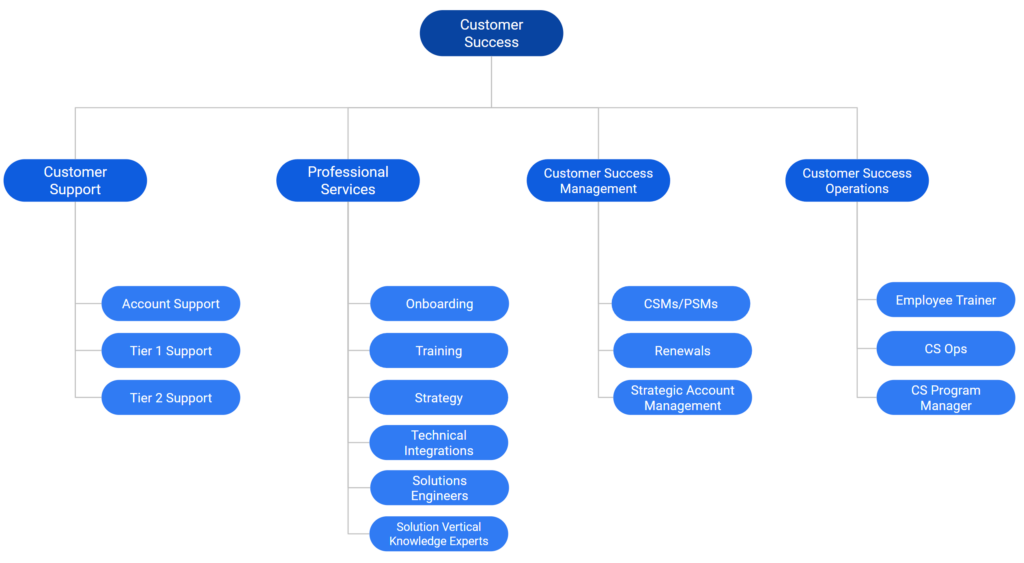
Customer Success is still a relatively new function, and in discussion with peers, there is still no clear answer for how a CS organization should be structured. My personal opinion is that it’s owning everything post-sales (and a bit pre-sales) to maximize the customer’s value. This includes owning the renewal rate and the retention rate numbers. As such, I structure CS organizations as follows:

Breaking this down:

      • Customer Support: For smaller companies I prefer the “Touch and Hold” model, which is the equivalent of hiring just Tier 2 Support individuals who are cross-trained to answer everything. As companies scale, and depending on the quality/structure of the product, you may need to add an Account Support team to handle provisioning (not onboarding) type activities, and tier your teams to optimize for cost and response times.

      • Professional Services: The PS function is a great department to handle teams that are necessary to help customers be successful that are structured in a “project” delivery manner. These include Customer Onboarding, Customer Training, Strategy for Customers, and Technical Integrations for Customers.
            • Two call outs for Professional Services:
                  • Having a team (frequently the largest) of Solution Vertical Knowledge Experts. While at Marketing Automation software company, this was a group of experts in email deliverability. While at a brand protection company, this was a group of experts in understanding and recommending how to remove online content. This group is key to helping customers obtain value and is a key differentiator for CSMs to leverage.

                  • Solution Engineers: I have become a proponent of having SE’s report into Customer Success. Sales training is not deep enough (unlike what happens within CS organization), and having Solution Engineers helps to ensure sales that are structured to ensure Customer Success vs. just getting the deal done. This role can be filled part time by management in PS, Strategists in PS, onboarding consultants in PS, or by the Solution Vertical Knowledge Experts vs. staffing 100% independently.

          • Customer Success Management: The CSMs themselves, who are directly accountable for the retention rate. Depending on your sales model, this team may include Partner Success Managers to ensure your partner/channel is successful. If you have a tech touch model solution, I also recommend a renewals team (but be careful as taking this off CSMs plate can start to remove accountability and increase customer friction), and finally a Strategic Account Management function.
                • Regarding Strategic Account Management: This role must be carefully defined! The CSM is responsible for renewal and potentially cross-sell and up-sell. Essentially growing the existing relationship within the account. The Strategic Account Manager is responsible for selling into new relationships within an existing account. This role can be in either CS or in Sales, as it requires a sales persona.

            • Customer Success Operations: This is a team of individual contributors who exist to make the other customer facing CS departments successful. The CS Ops person is responsible for timesheet updates, utilization reports, CS health metrics, and managing all CS Software tools. The CS Trainer is responsible for all new and existing CS employee education. The CS Program manager is responsible for all processes and procedures within the organization, and managing all CS Improvement projects. Additional optional roles within these team can be the Community Manager, KB Manager, or CS Tools Engineer. Having worked for smaller companies, I typically ask the managers to take on these responsibilities until we’ve scaled to the point of needing these roles full time.

          All of this being said, every company is different. The size of the company, whether you have an enterprise customer model or a tech touch customer model, whether you are true SaaS or a SaaS/MS hybrid, and more all impact the above structure. That being said, if you aren’t doing one of the above functions, the question should be asked “who is?” and if it’s not clear, then it’s not happening, to the detriment of your customers, and your retention rate.